Sunday, September 30, 2012

A Personal (more so than usual) Response to The Unnamable: Dr. Strangevoice or; How I Learned to Stop Worrying and Love Death

Well, not really love death, but get over it a little? I'm not sure, the act of reading this helped though. And a minor disclaimer, this post is mostly personal but I will attempt to give it some academic value.


"But it is quite hopeless." - Selected Works Vol. II, 286

When not reading Beckett in my copious amount of free time, I try to occupy my mind with other things. Whenever I happen to have a mind much like Zuccotti Park after evacuation day, I always seem to be focused on the same thought time and time again, “Help me god. I am going to die.” I’m not going to lie, it’s a scary one that has caused me a lot of trouble at the expense of radical decisions made from desperate affirmations in defiance of existential ennui. However, it’s usually (no, no, it is always) all in vain.

But while reading The Unnamable, I was given a break from this demoralizing thought, while being confronted with someone (or something else) battling the exact same idea (or so it seemed that way). I found hope, if I should call it that, in the hopeless, and a sense of bliss instilled in me while watching “the Unnamable” unravel like I am so prone to do.

My mind, whilst unoccupied. 
It was nice and a little relieving to watch the narrator struggle with the same things I do:
“Mean words, and needless, from the mean old spirit, I invented love, music, the smell of flowering currant, to escape from me. Organs, a without, it’s easy to imagine, a god, it’s unavoidable, you imagine them, it’s easy, the worst is dulled, you doze away, an instant. Yes, God, fomenter of calm, I never believed, not a second” (299).
I touched on this slightly before in my post about Belacqua and the arts, but the best way to distract yourself from mortality is to occupy your mind, and the narrator seems to reassert this belief. The incessant need to escape oneself, to divert your thought to allow a few moments of tranquility while ignoring your temporary condition in an insignificant sphere of existence. It gets tiring, and sometimes, at least for me, it’s easy to pass off your ignoring onto something tangible, like a God, to calm yourself, to believe in an inherent meaning. It makes life easier. But then again, as is always the case, I come back not to believe. Now I wouldn’t call myself an atheist, and I’m really not an agnostic, it’s hard to explain anyway so I’ll spare you the rhetoric.

The “Unnamable,” hits me again: “I, of whom I know nothing, I know my eyes are open, because of the tears that pour from them unceasingly” (298). While constantly confronting the impossible thought of an eternity of nothingness, it can overwhelm us with fear, and a sense of sadness. It’s not easy to accept, no, it never is, and some might suggest that we just ignore it all together, but no, no, I must go on.

It's always near.
Well, like I said, this post is very personal and I’ll selfishly use it in a casual tone because to be honest, it is nice. Venting every now and then publicly never hurt anyone…(irony). But, anyway, in the middle of the linguistic whirlwind that The Unnamable is, I find somewhere among the silence a sense of extreme hope:
“No, they have nothing to fear, I am walled round with their vociferations none will ever know what I am, none will ever hear me say it, I won’t say it, I can’t say it, I have no language but theirs, no, perhaps I’ll say it, even with their language, for me alone, so as not to have not lived in vain, and so as to go silent, if that is what confers the right to silence, and it’s unlikely, it’s they who have silence in their gift, they who decide, the same old gang, among themselves, no matter, to with silence, I’ll say what I am, so as not to have not been born for nothing” (319).
Even while confronting our inescapably current existence, our death, and how those before us have come to define everything and manipulate our current sect of thinking, the Unnamable goes on in defiance, in revolt. Even though it’s all in vain, it’s nice to try and defy that. Anyway, I’m not sure if I've said much, other than, “I’m afraid to die, Beckett made me not think of that for a little bit,” and, “I like the defiance of the Unnamable to keep on going.” After all, he “can’t go on, I’ll go on” (407). 

This song both has everything and nothing to do with what I've just written about. Listen to it. Enjoy it.


Wednesday, September 19, 2012

Grotesque Eroticism and the Birth of Death in Malone

REVISION: "It is true love in the rectum." -Skunk G. Wilson 


In both Molloy and Malone Dies, Beckett delightfully delivers us grotesque descriptions of "love making," or perhaps (the Kafka returns) the more appropriate term: fucking. In Molloy, we face a man who has sexual relations with perhaps his androgynous grandmother, Ruth, but we cannot be sure. We can never be sure. In Malone dies, the perhaps fictional character, perhaps semi-autobiographical Macmann, confined to an asylum, begins to take part in some mutual sexual fondling with his caretaker, Moll (oddly similar to "Molloy," is it not, perhaps he may even just be M(alone)). In either case, both spectacles of sexing it up are described in incredibly grotesque manners.

(Enticing, no? AND FOR GOD'S SAKE KEEP  THE SAFE SEARCH ON WHEN YOU LOOK FOR IMAGES OF NASTY GRANDMA)
In Malone Dies, Macmann's partner is described as being utterly repulsive. She is old, ugly, and has gigantic lips that take up half of her face (Selected Works, Vol. II 250). She begins to develop a foul stench, her teeth fall out, and she spends half of her time sitting in Macmann's room vomiting on herself (258). Devilishly sexy, no? Don't be a prude, "the sight of her so diminished did not damp Macmann's desire to take her, all stinking, yellow, bald, and vomiting, in his arms. And he would certainly have done so had she not been opposed to it" (258).  Her sickly appearance begins to remind us of Molloy's grandmother as well (is there a connection here? Perhaps...).

When they do commence to getting in a little wham, bam, thank you ma'am, Beckett, or at least the narrator describes it rather painfully: "The spectacle was then offered to Macmann trying to bundle his sex into his partner's like a pillow into a pillow-slip, folding it in two and stuffing it in with his fingers. But far from losing heart they warmed to their work. And though both were completely impotent they finally succeeded, summoning to their aid all the resources of the skin, the mucus and the imagination" (253). Why does Beckett (or Malone)  give us such a strange and unpleasant description? 

(That's not living, that's living.)
Well, in my opinion, we are given such horrid depictions of the act of sexual intercourse because Beckett is working within the minimalist style. When we strip down the fancy fantasies of "making love" to the very basis of its actions, an erect penis smashing into a slimy vagina until the release of a frothy mixture (okay, perhaps I tried to make that sound a little more repulsive) we are left with something a little less romantic, but still all the more passionate. But more importantly, whence the spluge has been splurged, what is the product of this beastly fucking? A glorious child! Imagine that, life crafted from the confines of a nude ramming festival. 

What we are left with after this, is the fact that life is created out of a rather strange, and at times repulsive, action. And not only is life created, but with each creation of life, comes death. And does not Beckett's work function in the same way? We can say his work is a little unconventional, sure, and that it is often strange and sometimes repulsive. But still, out of the passion comes the life of his art, and often when we reach the end of it, its death. Personally, I believe that through these odd sexual escapades (I know, I know, NO SYMBOLS WHERE NONE INTENDED), comes visions of the creation of art, and the often toils and sufferings one encounters while creating it (or at least the good stuff). And also, from these naughty actions, comes life, but always (100% of time) with the consequence of death. It is also rather absurd isn't it? But oh well, shut up, put out, and enjoy the silence.

Dirty Dustin Hoffman takes a bath.


Monday, September 10, 2012

How All Things Hang Together (Molloy vs. Jacques)


But is it true love, in the rectum?” -Samuel Beckett (Selected Works, Vol. II 52)


(Molloy and Jacques, or Jacques and Molloy? Complex, isn't it?)

At first glance while reading Molloy, Molloy and Jacques Moran seem to be two entirely different people. Molloy, a crude, decrepit, and sick man; Jacques the antithesis: composed, healthy, wealthy, and God-fearing. But after traveling through the consciousness of both men’s minds, we discover that the two may just be one in the same.

They share many things in common. Molloy states in the beginning of his section that he may have a son, “Perhaps I have one somewhere” (3). Jacques is also quick to state his kinship, “My son is sleeping. Let him sleep…His name is Jacques like mine” (87). Both men write: Molloy, “When he comes for the fresh pages he brings back the previous week’s. They are marked with signs I don’t understand” (3); Jacques, “My report will be long. Perhaps I shall not finish it …I went back into the house and wrote, It is midnight” (87/170). Both men have a Sunday visitor: Molloy’s coming at the end of every week to collect his papers, he is also “always thirsty” (4); Jacques’ being Gaber, who asks for a beer and a refill, “I could do with another,” implying that he too is also very thirsty. Gaber also owns a notebook written in code that Jacques admits to not being able to understand. Both men have handicapped legs, needing crutches. Both begin to develop the same vocabulary and sayings: constantly using that Kafkaesque “perhaps,” keen on the usage of “molestations,” and making the clear statement that neither are ever able to answer the question, “what am I doing?” (167). And finally both men possess the same habits and fixations: sucking on pebbles, arrange items in an obsessively compulsive pattern (Molloy the pebbles, Jacques the shirt), desires for bicycles, and fascinations/contemplations with the idea of love.
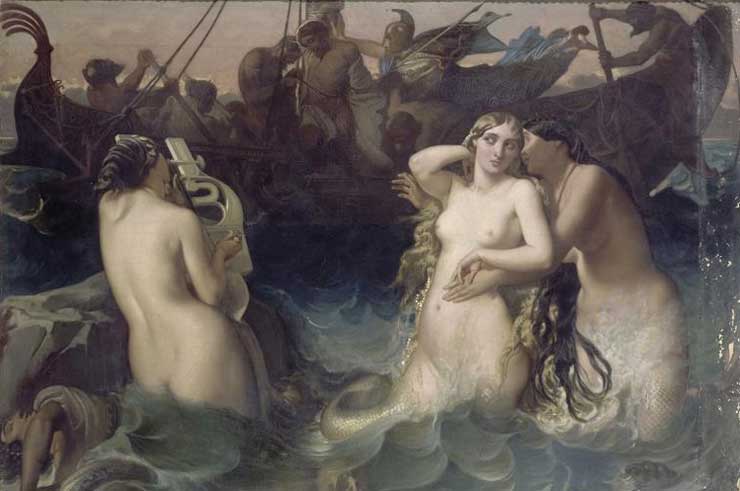
(Odysseus and the Sirens)

In the sense of literary allusion, both men seem to follow along paths of ancient epic heroes. Molloy’s travels mirroring those of Odysseus: constant wandering, extended stays with women (compare Lousse to the sirens), and troubles returning home (compare Odysseus’ wife to Molloy’s mother). Jacques’ journey reminds us of Dante’s Divine Comedy. Both journeys begin in the woods, both men first travel through Hell (Jacques’ trip through the woods constantly worsens), then Purgatory (Jacques’ son, Jacques, leaves him stranded after most bodily damage to his father has been done, making him sort of waiting in an ambiguous space for an answer), and ending in Paradise (for Dante it is witnessing God and understanding his beauty; for Jacques it is returning home where he describes his journey as a “pilgrimage,” and states “They were the longest, loveliest days of all the year. I lived in the garden,” as well as stating “I understood it, I understand it all, all wrong perhaps” (169/170)).

But Jacques’ stay in the garden is brief and he returns to his house to write, ending the story in a sort of cyclical manner (if we are to believe that Jacques and Molloy are the same). Molloy states in the beginning that “It was the beginning, do you understand? Whereas now it’s nearly the end” (4). In the middle of his story he claims “I used to be quick and intelligent,” reminding us of Jacques’ quick wit seen in the second section of the novel (30). Molloy epically states “all things hang together,” giving us the idea that these stories are somehow connected in more ways than one, that as it all hangs together. Jacques and Molloy are one in the same.

Like Joyce’s Finnegan’s Wake, the novel has no true beginning and no true end. Instead we are left with a full circle, never ending, never beginning, as we get lost in the ambiguity of who is who and what is happening, watching it all hang together, trapping us in a sort of Beckett limbo. 

Anyway, here's Spongebob and Patrick fighting it out over their own identity crisis

Friday, September 7, 2012

Alone, Together or, Beckett's "Company"


If a tree falls in a forest and no one is around to hear it, does it make a sound?

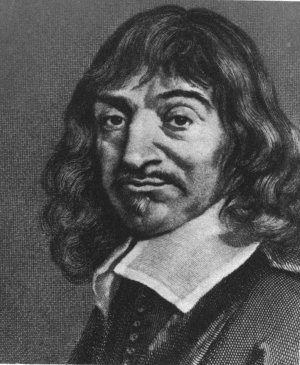
(Forever Alone Descartes) 
While reading Company, I began to notice the narrator narrating a narration – “Devised deviser devising it all for company. In the same figment dark as his figments” (Selected Works, Vol. IV 443). It seemed as if the narrator had some sort of affirmation to make to himself. To affirm his existence he had to narrate, or project even, in order to feel some sort of belonging or company; or merely to avoid what I believe we humans fear most – being alone, as we “devise it all for company.” This pattern reminded me of Descartes famous “Cogito.” If I think therefore I am, then my thoughts serve as the projected perception of reality. But if my thoughts are solely what determine my existence, something human is lost. I am alone. The narrator in the story seems to be affirming his existence, like one would use the “Cogito,” however, he is only affirming his existence to himself. The narrator becomes aware of himself devising plots, characters, reliving memories, and then criticizes himself for doing so, “Yet another still devising it all for company” (449).

(This is a Tree. Falling Alone.)
            Even though the narrator catches himself in the act of “devising it all for company,” he still ends up precisely where he began: Alone. And until some outside force encounters the narrator, he will always remain that way. I think that this may be Beckett critiquing Descartes’s “Cogito.” If I think, therefore I am determines existence, then the I will always be alone in that existence. Like the narrator trapped inside his own mind, proving his own existence to himself, the person using the “Cogito” will only do the same and inevitably each time end up alone, until someone else comes along to prove otherwise. And is that not the Hell Sartre tells us of? We can only exist through other people. But do you see the beauty in that? 
                                                                             Anyway, I’ll revamp that life-long, unanswered riddle:

If a child is born in a world and no one is around to see it, does it live a life?*

*Author's Note:
                             Even if that child were to be seen by other people, even interact with them, the child must still suffer the fact that even though it may not be alone in the world, he or she or it will still always be alone inside (s)he/its own mind, or imagination. Trapped inside our own conscious thought, we are condemned there forever until death, where we finally reach the epitome of loneliness, or maybe more optimistically, an epitome of company as we all for the final time come alone, together. 

Anyway, here's Squidward Tentacles' attempt at facing the ultimate alone, and I feel as if his reaction is one that belongs to us all. 


Wednesday, September 5, 2012

Belacqua's Fear of Death (Ennui and the Arts)

"Disbelief is a bore. We do not count our change. We simply cannot bear to be bored." (Selected Works, Vol. IV 116)


(The Real Belacqua)
     If we are to agree with the Jesuit's statement given in "A Wet Night," we can see throughout Belacqua's stories, specifically "Ding Dong," that he fears boredom, but ultimately lingering behind this boredom is the fear of death. The narrator of the story begins by telling us that Belacqua held the "belief that the best thing he had to do was to move constantly place to place...The mere act of rising and going, irrespective of whence and whither, did him good" (99). Traveling poorly from place to place, Belacqua has reached a point in his life where he is constantly on the move, frequently diving into seedy bars for his desired gin and tonics. If you constantly fear something, what is the best way to ignore it? -Occupy your mind. By continuously moving, Belacqua's mind is rarely at rest, allowing him to ignore his real fear: Death. Although, when aware of why he is traveling so much, "He was at times tempted to wonder whether the remedy were not rather more disagreeable than the complaint, but he could only suppose that it was not, seeing that he continued to recourse to it" (99-100). The remedy is travel, the complaint is Death, or knowing that he is eventually going to die. I believe that Belacqua suffers from some sort of existential ennui. He is described as a poet and often times turns to art, specifically music, not religion, to calm his anxiety: "A great major symphony of supply and demand, effect and cause, fulcrate on the middle C of the counter and waxing, as it proceeded, in the charming harmonics of blasphemy and broken glass and all the aliquots of fatigue and ebriety. So that he would say that the only place where he could come to anchor and be happy was a low public-house" (104). Here in the public house, Belacqua is able to transcend himself, becoming comfortable without being on the move. The music of the place, the symphonies of sorrow, calms him. 
     Throughout the story, we see fixations on death: the paralytic blind man in the wheel chair, a pedestrian girl run over in the street, and constant images of darkness. Belacqua focuses on death, for as an artist he must constantly be aware of it - if he is going to make art, then his work will be immortal, or at least live long passed him; this alone should naturally cause anxiety, knowing that a piece of work will serve as a representation of yourself long after you are gone. He is always confronting his mortality each time a work is created. His fixations on death seen throughout the stories tell us he is definitely concerned with it, and his uneasiness and constant travel shows that he fears it. 
(A seedy Irish Bar (in Ft. Lauderdale), similar to the ones Belacqua may have encountered)
     In "Ding Dong," sitting in the dark bar, Belacqua becomes fascinated with a woman, specifically her face which "was so full of light" (105). More importantly, Belacqua is so interested in her because her face "bore no trace of suffering" (106). Suffering, or rather release from death. Belacqua constantly suffers and to see this face mystifies him. He is lost in her and "at her mercy" (106). He transcends himself and his suffering into her light, and being the first human he does so with (not art), he opens up entirely, possibly believing in something, and the experience is so profound he instantly denies her and breaks out into an incredibly anxious sweat. He does this because he is completely vulnerable at the mercy of a woman who allows him to transcend himself, and being in this situation, he has no other reaction but fear from its profoundness. After the encounter, Belacqua "tarried a little to listen to the music. Then he also departed, but for the Railway Street, beyond the river" (107). To recover from the event, he tries once more to hear the music, and then leaves, heading away from the woman at the bar. He experienced true love with this woman, and understanding the beauty of art and passion, he had to leave to preserve its wonder.
     Belacqua's fear of death positions himself as an artist and a lover. With the constant anxiety of knowing we are to die, sentiment that grasps our existence as something profound, transcendent and beyond, pulls Belacqua in to experience moments of true beauty. Like Proust and Wilde, Belacqua suffers constantly throughout More Pricks than Kicks, allowing him to be an artist, understanding beauty to the level of creating it. 


(Cutler) Beckett confronting Death