“But is it true love, in the rectum?” -Samuel Beckett (Selected Works, Vol. II 52)
 |
| (Molloy and Jacques, or Jacques and Molloy? Complex, isn't it?) |
At first glance while reading Molloy, Molloy and Jacques Moran seem to
be two entirely different people. Molloy, a crude, decrepit, and sick man;
Jacques the antithesis: composed, healthy, wealthy, and God-fearing. But after
traveling through the consciousness of both men’s minds, we discover that the
two may just be one in the same.
They share many things in common. Molloy
states in the beginning of his section that he may have a son, “Perhaps I have
one somewhere” (3). Jacques is also quick to state his kinship, “My son is
sleeping. Let him sleep…His name is Jacques like mine” (87). Both men write:
Molloy, “When he comes for the fresh pages he brings back the previous week’s.
They are marked with signs I don’t understand” (3); Jacques, “My report will be
long. Perhaps I shall not finish it …I went back into the house and wrote, It
is midnight” (87/170). Both men have a Sunday visitor: Molloy’s coming at the
end of every week to collect his papers, he is also “always thirsty” (4);
Jacques’ being Gaber, who asks for a beer and a refill, “I could do with another,”
implying that he too is also very thirsty. Gaber also owns a notebook written
in code that Jacques admits to not being able to understand. Both men have
handicapped legs, needing crutches. Both begin to develop the same vocabulary
and sayings: constantly using that Kafkaesque “perhaps,” keen on the usage of “molestations,” and making the clear
statement that neither are ever able to answer the question, “what am I doing?”
(167). And finally both men possess the same habits and fixations: sucking on
pebbles, arrange items in an obsessively compulsive pattern (Molloy the
pebbles, Jacques the shirt), desires for bicycles, and
fascinations/contemplations with the idea of love.
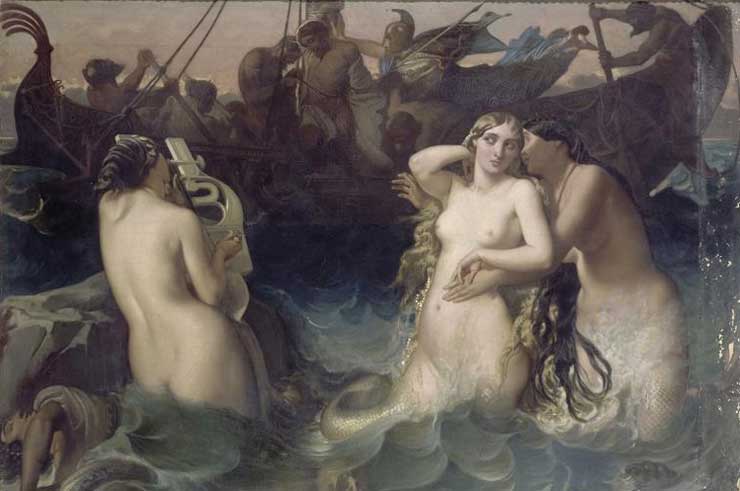 |
| (Odysseus and the Sirens) |
In the sense of literary allusion, both men
seem to follow along paths of ancient epic heroes. Molloy’s travels mirroring
those of Odysseus: constant wandering, extended stays with women (compare
Lousse to the sirens), and troubles returning home (compare Odysseus’ wife to
Molloy’s mother). Jacques’ journey reminds us of Dante’s Divine Comedy. Both journeys begin in the woods, both men first
travel through Hell (Jacques’ trip through the woods constantly worsens), then
Purgatory (Jacques’ son, Jacques, leaves him stranded after most bodily damage
to his father has been done, making him sort of waiting in an ambiguous space
for an answer), and ending in Paradise (for Dante it is witnessing God and
understanding his beauty; for Jacques it is returning home where he describes
his journey as a “pilgrimage,” and states “They were the longest, loveliest
days of all the year. I lived in the garden,” as well as stating “I understood
it, I understand it all, all wrong perhaps” (169/170)).
But Jacques’ stay in the garden is brief and
he returns to his house to write, ending the story in a sort of cyclical manner
(if we are to believe that Jacques and Molloy are the same). Molloy states in
the beginning that “It was the beginning, do you understand? Whereas now it’s
nearly the end” (4). In the middle of his story he claims “I used to be quick
and intelligent,” reminding us of Jacques’ quick wit seen in the second section
of the novel (30). Molloy epically states “all things hang together,” giving us
the idea that these stories are somehow connected in more ways than one, that
as it all hangs together. Jacques and Molloy are one in the same.
Like Joyce’s Finnegan’s Wake, the novel has no true beginning and no true end. Instead
we are left with a full circle, never ending, never beginning, as we get lost
in the ambiguity of who is who and what is happening, watching it all hang
together, trapping us in a sort of Beckett limbo.
Anyway, here's Spongebob and Patrick fighting it out over their own identity crisis

Kilian, When I read Molloy I picked up on what you are talking about a little bit. I could see some similarities between the two me. However, I had no idea how many connections in the text there were between the two characters. While I only saw the surface, you looked through the text and found quite a few good examples of how these two men are alike. I would not have picked up on vocabulary or fixations if you had not pointed them out. I also really like the connection you made to Spongebob and Patrick having an identity crisis over which one is Dirty Dan.
ReplyDeleteI'd like to second Carina's approval of the Spongebob clips.
ReplyDeleteYou make a convincing argument that Molloy and Moran are the same individual, or at least related.
ReplyDeleteThere's an asymmetry, though, between parts I and II that I'm trying to understand. Molloy's section is one long monologue delivered in a pretty consistent voice. At the end of part I, the "crude, decrepit, and sick man," as you call him, is still crude, decrepit, and sick. Molloy journeys, but he seems lost from the beginning.
Moran journeys too, but he starts from a place that differs from where he ends up. Compare any excerpt from the beginning of part II with an excerpt from the end of part II, and you can hear—in his meandering observations and odd associations—that Moran has transformed. What has he transformed into? Molloy, I think. (Possible Freudian slip: I had to edit this comment because I kept referring to someone named "Malone.") So, in part I we have a mind in stasis, while in part II we have change, from one type of mind (reasoning, fond of order) to another.
Maybe Beckett's expressing a preference. In part I, Molloy says that "the most you can hope is to be a little less, in the end, the creature you were in the beginning, and the middle" (28). Should one still hope to be a different creature, even if the creature you are in the end is more lost than the creature you were in the beginning? Reading Beckett's work, I feel myself like such an end creature: I'm less the creature I was in the beginning, but probably more lost.