I know there are no symbols where
none intended, but I want to try to comment on some of the meta-theatrical
aspects of Endgame. Beckett is a
writer that seems to be very aware of himself, his work, and the process of
creating. I think there is some inherent anxiety that comes along with being a
writer, especially when we write for the stage where an audience will be
directly interacting with the work in more ways than they would just reading the script.
And I think Beckett may just be expressing some of that anxiety within this
play. I hope this makes sense.
 |
| Be a practical player... |
Hamm sits at the center of the
stage, and is very anxious about remaining there:
HAMM:
Am I right in the center?
CLOV: I’ll measure it.
HAMM:
More or less! More or less!
CLOV: [moving
chair slightly] There!
HAMM:
I’m more or less in the center?
CLOV: I’d say so.
HAMM:
You’d say so! Put me right in the center! (The
Selected Works Vol. III 108)
Hamm then goes further on to
heckle Clov about whether or not he is exactly in the middle. Why does Hamm
have such a great concern for this? If by sitting in the center, does he feel
some sort of control over his environment, over his work? Perhaps.
The paradox of Hamm’s intense
desire to remain in the center sits in the fact that he is entirely blind and
entirely dependent upon Clov to place him there. He also tries to dictate Clov’s
every move, asserting his power with a whistle. Hamm wants to be in complete
control however, he is at the mercy
of Clov’s response to his demands. Much like Beckett (as we have learned was a
complete control freak when it came to the theater) would like to have control
over his work yet is at the mercy of the audience’s response to the play.
Hamm and Clov also express some
explicitly meta-theatrical moments throughout. Near the end of the play, Clov
asks:
CLOV: Will it not soon be the end?
HAMM:
I’m afraid it will.
CLOV: Pah! You’ll make up another.
HAMM:
I don’t know.
I feel rather drained.
The prolonged creative effort (134).
It (it, say it, not knowing what),
perhaps the play, will indeed soon end as we are nearing the final pages. Clov
says to Hamm he can make up another one (story, play, idea?), but Hamm is done.
He has grown weary of the “prolonged creative effort,” much like his father
Nell, who rests in the back in a trashcan attempting to tell an old story, of
which he professes, “I never told it worse…I tell this story worse and worse”
(105). Hamm responds to his father’s story with, “Have you not finished? Will
you never finish? Will this never finish?” (106). Everyone wants to keep going
on with the stories except Hamm. Perhaps this is Beckett authenticating his, “go
on, I can’t go on, I must go on.”
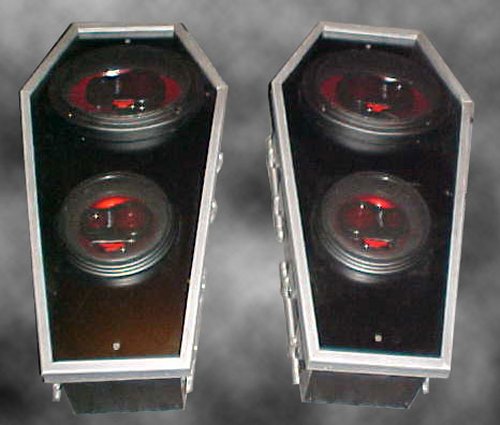 |
| Make as much noise as you'd like, you'll still end up dead. |
Even closer to the end of the
play, we have one of the last exchanges between Hamm and Clov:
HAMM:
Put me in my coffin.
CLOV: There are no more coffins.
HAMM:
Then let it end!
With a bang! [another Eliot jab here?]
Of darkness! And me? Did anyone ever have pity
on me?
CLOV: What? Is it me you’re referring to?
HAMM:
An aside, ape! Did you never hear an aside before?
I’m warming up for my last soliloquy (146).
Hamm specifically states two
theatrical devices, an aside and a soliloquy, letting us know that he is fully
aware of what is going on within and outside of the play. A little later on, we
learn Clov is entirely aware as well as he prepares to leave the stage for the
final time: “This is what we call making an exit” (149). If the two main
figures of the play are completely aware of themselves, what is Beckett trying
to say to us? Perhaps because a play is composed of real people playing fictitious parts (reality existing with art),
the real people are a part of a limited realm (much like life itself). No play
can go on forever, just like no person can live forever, all things must end,
all plots being towards death. Placing real people within this limited, ending
construct of a play brings them to awareness of their inevitable end, something
people tend not to consider too much while living. But an actor in a play is
aware that he will end, fully confronting his temporary condition. Perhaps
Beckett wants us to be aware of this fact of life ourselves, that all things
must end, and we will always lose: “Old endgame lost of old, play and lose and
have done with losing” (149). Makes you anxious, doesn't it?
Or maybe Beckett is just toying
with another accepted convention, breaking it and reinventing, “Him to play,” as
Hamm might say. Will we ever know for certain what Beckett was trying to say?
No. Oh, well, at least there’s something.
I
think this will help explain.

No comments:
Post a Comment